

Jagdeep Singh: the patient disruptor
Born in New Delhi, the serial founder has spent three decades betting on technologies that take a long time to work. His battery company is now close to finding out whether its biggest bet pays off.
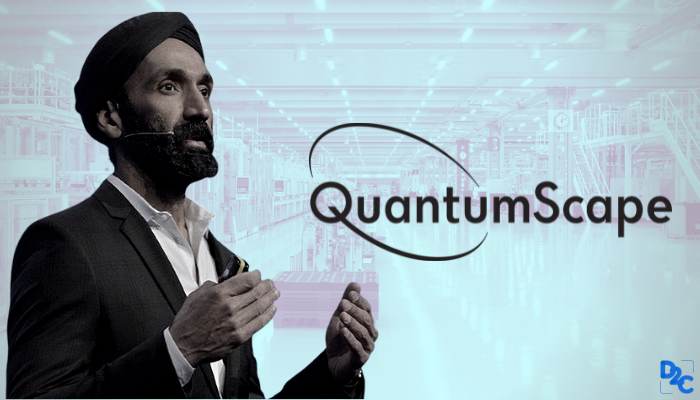
Most entrepreneurs who get rich once tend to stay in the industry they know. Jagdeep Singh has done the opposite. He has built companies in network software, then optical chips, then batteries and now robots, and each time he started more or less as a beginner. The approach is risky. Deep technology rarely rewards impatience, and for a decade or more it can look like a very expensive hobby. Singh has made that bet several times, and his best-known bet, the solid-state battery, is now nearing its real test.
A wandering childhood
Singh was born in New Delhi. His father was a statistician with the World Health Organization, and the job took the family through Africa and the Caribbean before they settled near Washington DC. Moving around early may explain a willingness to keep moving later. He was quick from the start: he graduated in computer science from the University of Maryland in 1987, aged 19. He went on to a master’s degree at Stanford and an MBA from Berkeley’s Haas School of Business. These three institutions gave him the usual Silicon Valley mix of engineering skill, business training and a network of contacts.
Learning the trade
After a spell at Hewlett-Packard, he started companies. Airsoft made software for connecting to corporate networks remotely. Lightera Networks worked on optical switching and was bought by networking-equipment maker Ciena. OnFiber built fibre networks in American cities. None of these is famous now, but together they taught him how to raise money, hire engineers and sell to cautious corporate buyers.
Infinera was his first truly ambitious company. Founded around 2000, it set out to put dozens of optical components onto a single chip, a photonic integrated circuit, so that carrying internet traffic would be cheaper and simpler. Sceptics said it was too hard. Infinera shipped anyway and listed on Nasdaq, with Singh as chief executive. The experience taught him what would become his working method: a hard technical problem, solved well, makes a strong business, but only for founders willing to wait years before the market sees any result.

From light to lithium
In 2009, after leaving Infinera’s top job, Singh became an entrepreneur-in-residence at the venture firm of Vinod Khosla, another Indian-born Silicon Valley figure. He had decided that the battery was the main thing holding back the electric car. It was too heavy, too slow to charge and, with its flammable liquid electrolyte, too prone to catching fire. He had no background in electrochemistry, so he started attending lectures at Stanford. There he met Fritz Prinz, a physicist who studied energy at the atomic level, and Tim Holme, Prinz’s graduate student. In 2010 the three founded QuantumScape. Holme became chief technology officer and Prinz joined the board.
The plan was to replace the battery’s liquid electrolyte with a thin ceramic separator and to drop the conventional anode. Instead, lithium metal would form in place when the cell was first charged. If it worked, the result would be more range, faster charging and less fire risk.
For most of a decade, QuantumScape worked out of public view. That is unusual for a start-up, but Singh had learned at Infinera that hard engineering has to come before publicity. Investors were willing to wait. Bill Gates, Kleiner Perkins, Khosla Ventures and auto-parts maker Continental all put in money. The most important backer was Volkswagen, which began working with the company in 2012, invested $100 million in 2018 and added $200 million in 2020.
Public scrutiny
In November 2020, QuantumScape listed through a merger with a blank-cheque company, Kensington Capital Acquisition, at a valuation of about $3.3 billion. Within weeks, retail investors had pushed its value close to $50 billion, more than some established carmakers, even though it had no revenue. Short-sellers then questioned its results and the shares fell sharply. For a company built on patient, private work, the sudden attention was a strain. Singh spent the next few years defending the science and publishing test data.
In early 2023 he started planning his own succession. He wanted someone who had run large-scale manufacturing of complex technology, because that would be the next stage of the job. In February 2024 he handed over to Siva Sivaram, a semiconductor-industry veteran.
The road to the car
Since then, the company has moved from lab work towards the car industry. In 2024 it agreed to license its technology to PowerCo, Volkswagen’s battery unit. Under that model QuantumScape supplies the technology and its partner builds the factories, which keeps QuantumScape from having to fund gigafactories itself. In October 2025 it began shipping its QSE-5 B1 sample cells and showed them powering a Ducati V21L electric racing motorcycle, its first public demonstration in a vehicle.
This week it went a step further. On November 11, QuantumScape unveiled Osprey, a platform aimed at the main weakness of a rival battery design. Sulfide solid electrolytes conduct lithium well, but they usually only work when the cells are squeezed under heavy pressure, and the clamping hardware adds weight and cost to a car’s battery pack. QuantumScape says that in early tests, Osprey cells completed 1,000 charge cycles at normal air pressure, kept about 80% of their capacity, and charged from 10% to 80% in five minutes. The company is offering Osprey for licensing to carmakers and even to rival battery developers. It cautions that the results are early and may not carry over to mass production. Still, the strategy is unchanged from 2010: solve the hardest problem, then let others build on the solution.
Starting again
Singh, meanwhile, has started over once more. In 2024 he founded Rhoda AI, which is building intelligence for industrial robots. Most rivals train robots by having humans demonstrate tasks; Rhoda trains its models on vast amounts of internet video. Manufacturing, including car plants, is one of its target markets. In March 2026 it emerged from stealth with a $450 million Series A at a valuation of about $1.7 billion. The round was led by Premji Invest, the investment firm of Indian billionaire Azim Premji, which gives the company a link back to the country where Singh was born.
The lesson
Singh’s career does not fit the usual start-up story of quick growth and quick wins. His companies have taken years to show results, have attracted sceptics, and have needed investors willing to accept long delays. For India’s growing number of deep-tech founders, working on batteries, chips and electric vehicles with little patient capital at home, his example is useful because it is unglamorous: choose a hard problem, find the scientists who understand it, and be prepared to wait a long time for proof. QuantumScape’s next few years will show whether this bet pays off. Either way, Singh has already moved on to the next one.
Related Stories
Africa Takes Its Own EV Policy Framework to COP31, Puts Industrialisation at the Centre of Mobility Transition
The African Union's continental electric mobility framework seeks to move the region beyond vehicle electrification towards local manufacturing,...

XPeng targets 20-plus Middle East and Africa markets by 2027 as GX SUV orders top 4,000
XPeng targets 20-plus Middle East and Africa markets by 2027 as GX SUV orders top 4,000 Chinese electric...

Samsung and Hyundai Expand Partnership Across 3 Future Mobility Technologies
Samsung and Hyundai expand partnership from car parts into robotics, energy and AI South Korean conglomerates seek to...