

Volkswagen is not choosing India. It is affording it.
Škoda and Volkswagen executives flew to Mumbai to hail India as a priority. Days later, their chief executive told colleagues back home that the group's situation was "more than critical." Dig into the balance sheet, and the India retreat looks less like strategy and more like a symptom.
A chill has settled over Wolfsburg even as Volkswagen and Škoda executives basked in Mumbai’s August heat. On August 18th, they unveiled a refreshed Škoda Slavia and confirmed a compact SUV built specifically for India, for launch in 2027.
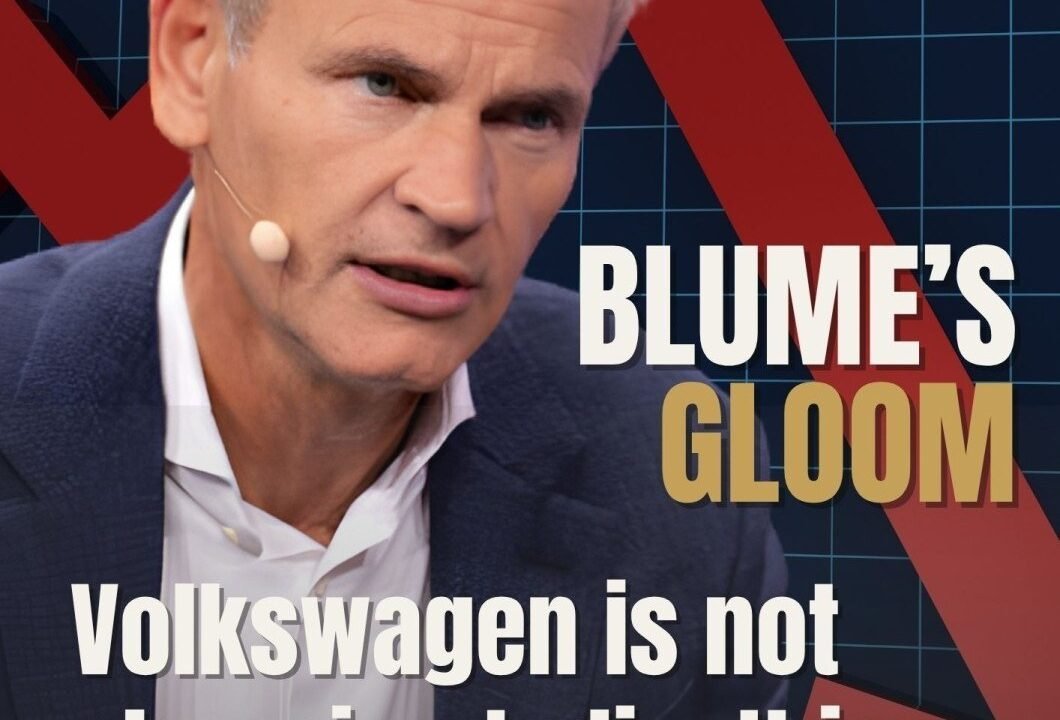
Soon, Reuters reported, Oliver Blume, the group’s chief executive, told colleagues in an internal memo that “the situation is more than critical,” ahead of a supervisory board meeting on September 4th expected to continue talks on German job cuts and plant closures, with no final decisions yet made. Set the two events side by side, and an uncomfortable question follows: is Volkswagen courting a partner in India because it wants to, or because Wolfsburg can no longer afford not to?
Strategic Revisions Worldwide
The evidence points toward compulsion, not choice. In the first half of 2026, group revenue held near €158 billion, but net profit fell 31% to €3.1 billion and automotive net liquidity slipped to €32.75 billion. India is not an isolated retrenchment. In the same weeks of August 2026, Volkswagen agreed to sell a 51% stake in Everllence, its energy-engineering unit, to Bain Capital for roughly €7.4 billion. The company also recently agreed to sell Porsche’s IT and consulting subsidiary MHP Management‑ und IT‑Beratung GmbH for €320 million ($373 million) to Tata Consultancy Services.
It confirmed the automaker is still working toward a longstanding target of cutting its stake in truck subsidiary Traton, from the current 87.5% (itself reduced from 89.7% in a March 2025 stock placement) to 75% plus one share. And it sent finance chief Arno Antlitz to its flagship Hannover plant, running at roughly 60,000 vehicles a year, well short of the plant’s original 100,000-unit annual target, for a works meeting on August 31st amid open speculation about closure or relocation to Poland. In Volkswagen’s own statement announcing the deal, Antlitz described the Everllence sale as a way to “strengthen its fiscal position and increase the company’s financial flexibility”.

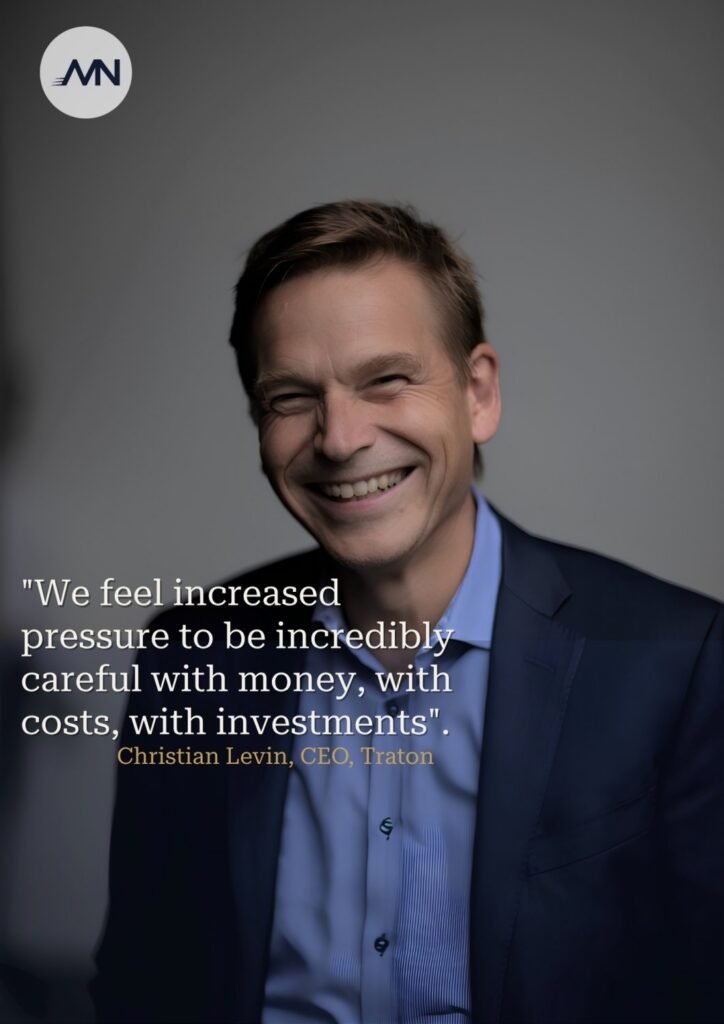
Traton’s own chief executive, Christian Levin, put the underlying pressure more bluntly in an interview with Bloomberg News published August 14th, just a few weeks before this piece: “We feel increased pressure to be incredibly careful with money, with costs, with investments”. Four separate assets, one underlying reason. Skoda’s global chief executive, Klaus Zellmer, rejects that reading, at least for India specifically. “We’re not desperate. We have a solid plan for India, standalone with a partner,” he told reporters in Mumbai, according to a media report, framing talks with JSW as a way to gain “momentum” rather than shed risk.
The official record supports that framing only loosely: Volkswagen’s own investment in a dedicated India EV platform was quietly cut from a planned $1 billion to roughly $700m last November, a decision Bloomberg attributed to two decades of returns yielding barely 2% market share, not a group-wide cash crunch. Nobody at Volkswagen has said, on the record, that we are selling India because Wolfsburg needs the cash. Nobody needs to. The pattern speaks for itself.
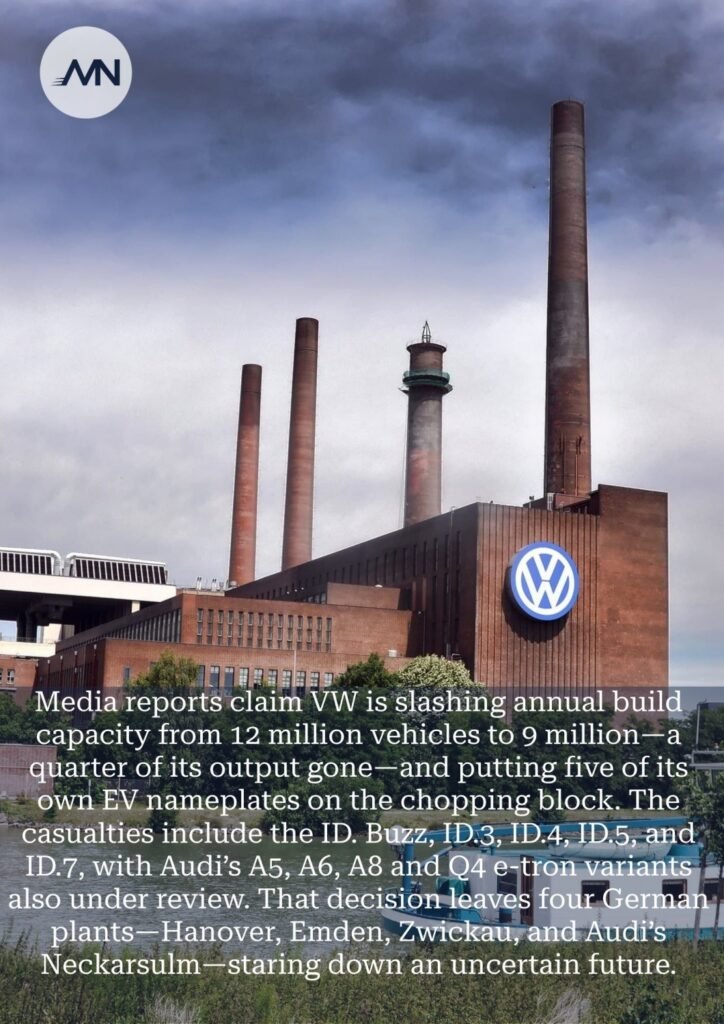
Volkswagen also sent the clearest signal yet that the era of unchecked expansion is over. The company is slashing annual build capacity from 12 million vehicles to 9 million—a quarter of its output gone—and putting five of its own EV nameplates on the chopping block. The casualties include the ID. Buzz, ID.3, ID.4, ID.5, and ID.7, with Audi’s A5, A6, A8 and Q4 e‑tron variants also under review. That decision leaves four German plants—Hanover, Emden, Zwickau, and Audi’s Neckarsulm—staring down an uncertain future.
EVs and China’s Drag
Why the crunch exists is no mystery. EVs remain the biggest drag: Antlitz told InsideEVs that VW’s EVs run at only 70-80% of the margin of equivalent petrol models, and that parity will come only “with our future SSP platform,” a unified architecture now delayed to the end of the decade.
Cariad, the group’s software arm, ran up close to €7 billion in operating losses between 2022 and 2024 without shipping working software, forcing an outsourcing deal with Rivian worth up to $5.8 billion. China, once VW’s most profitable market, is now its steepest loss: deliveries fell 25.9% in the first half of 2026 and 36.6% in the second quarter, leaving the century-old market leader third behind BYD and Geely, a ranking 2026 has only entrenched.
American tariffs on Mexican-built exports added roughly $3.3 billion in costs through most of 2025, prompting Mr Blume to concede to Autoblog that “exporting vehicles from Mexico to the U.S. is no longer economically viable under current conditions”. And Porsche, usually the group’s profit engine, wrote down €3.9 billion, abandoning its all-electric flagship, collapsing automotive operating profit by 98% in a year. Germany’s labour arithmetic underlies it all.
A December 2024 pact with IG Metall guarantees jobs at German sites through 2030, in exchange for more than 35,000 planned cuts and roughly €4 billion a year in savings. A further round, which Mr Blume has floated at up to 50,000 more cuts, must be negotiated around that guarantee, not through it, which is why his memo, reported by the media, cited overhead costs “more than 30% higher than comparable firms” without naming a single closure. Four plants, including Hannover and Zwickau, are flagged as unlikely to reach competitive capacity before the 2030s.
Brazil is Volkswagen’s genuine bright spot. South American sales rose 10.6% in the first half of 2026, Brazil alone up 21%, backed by a R$20 billion ($4 billion) investment through 2028 that Hendrik Muth, Volkswagen’s South America sales and marketing vice-president, told local trade press is “the fastest-growing” region for the brand worldwide.
America is thinner ground, with roughly 2% market share and tariff exposure Volkswagen has no clean fix for. Europe, the home market, is eroding fastest: The German brands’ share of the domestic electric-car market fell from 63.5% to 54.2% in the first half of 2026, with “market leader Volkswagen losing out the most,” and BYD outselling Volvo in Germany for the first time. That precedent cut both ways. Toyota is funding its own Indian expansion, a $1.9 billion push into three new plants, through its long-standing joint venture with Kirloskar rather than going it alone. Stellantis (Fiat) has run India for two decades through an even more balanced 50:50 venture with Tata.
Neither is treated as a retreat. What makes Volkswagen’s case different is direction, not structure: Toyota and Stellantis built their partnerships from the start; Volkswagen is proposing to hand away control it already held. Whether that counts as a shrewd correction or a distress signal dressed up as strategy may matter less than the fact that Volkswagen no longer has the balance sheet to keep pretending it is a choice. In the end, the chill from Wolfsburg reached Mumbai before the delegation’s plane did.
Related Stories

Mahindra Group Automotive Division CEO Nalinikanth Gollagunta moves to Group Corporate Development role
Mahindra Group has appointed Nalinikanth Gollagunta as Executive Vice-President and Head of Corporate Development, moving him from his...

AI influences car buying, but 90% of consumers still purchase through dealerships: Bain & Company
Survey of 12,351 consumers highlights regional differences in buying priorities, EV adoption barriers and growing competition for automakers

CBAM Casts a Shadow Over India’s $6.8-Billion Auto Component Exports to Europe, and Over European Carmakers Too
Europe’s carbon levy does not cover cars or car parts, but it taxes the metals they are made...