
The Volkswagen Warning: 100,000 job cuts expose the crisis facing all of Europe’s carmakers
Volkswagen's decision to cut 100,000 jobs and close four plants is Europe's loudest car-industry story of 2026. It is not a Volkswagen story alone: a shrinking market, Chinese challengers, boardroom upheaval, thinning margins and an expensive scramble to rebuild vehicle platforms are squeezing every legacy carmaker on the continent.
Volkswagen’s supervisory board approved, in the first days of September 2026, the largest restructuring any legacy carmaker has attempted: 50,000 more job cuts worldwide on top of a first wave already under way, taking the total toward 100,000, and four German plants — Zwickau, Emden, Hanover and Audi’s Neckarsulm — stripped of production work by the early 2030s.
Management named its reasons precisely: American tariffs, a weakening position against Chinese electric-vehicle makers, and more than 500,000 units of structural overcapacity across Europe. Markets liked the clarity — VW shares rose 6% — but the harder fight, over Oliver Blume’s plan to spin the VW brand into its own entity, was merely deferred: Lower Saxony, which holds a blocking 20% stake, vetoed it.
A Shrinking Market, New Entrants
Behind the cuts is arithmetic. The EU registered roughly 13m new cars in 2019; even after two recovery years it managed only 10.8m in 2025 — still close to a fifth smaller. In a market of that size, one carmaker’s gain is another’s loss. Volkswagen’s own EU share actually rose, from 25.2% in 2022 to 27.6% in 2025, before slipping to 26.5% in the first half of 2026.
Chinese brands explain where that lost share is going: BYD’s EU share went from 0.4% to 2.2% in eighteen months and MG’s from 1.5% to 2.2%; combined Chinese-brand share roughly doubled, to 6%, in the year to April 2026. JATO Dynamics has tracked BYD overtaking “Fiat, Dacia, and Seat” outright in several national markets.
Not Just Volkswagen
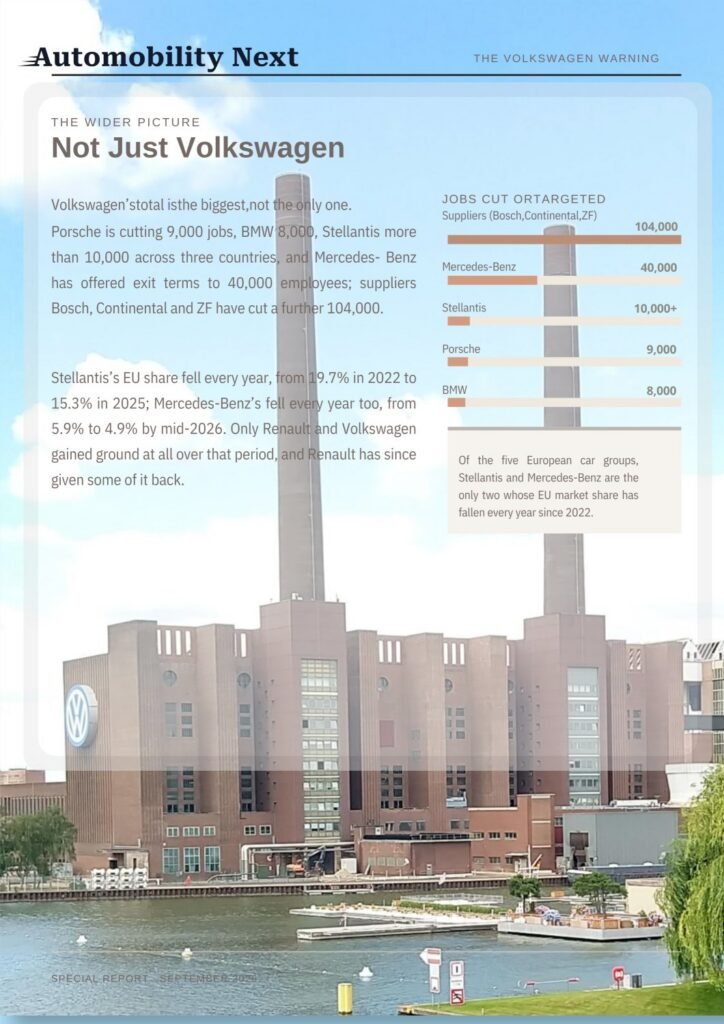
Volkswagen’s total is the biggest, not the only one. Porsche is cutting 9,000 jobs, BMW 8,000, Stellantis more than 10,000 across three countries, and Mercedes-Benz has offered exit terms to 40,000 employees; suppliers Bosch, Continental and ZF have cut a further 104,000. Stellantis’s EU share fell every year, from 19.7% in 2022 to 15.3% in 2025; Mercedes-Benz’s fell every year too, from 5.9% to 4.9% by mid-2026. Only Renault and Volkswagen gained ground at all over that period, and Renault has since given some of it back.
Boardrooms Under Strain
The pressure has cost executives their jobs too. Stellantis’s Carlos Tavares, architect of the 2021 merger that created the company, was out in December 2024 after clashing with his own board over targets it judged unworkable; his successor, Antonio Filosa, has since committed Stellantis to a $70 billion, five-year turnaround. Renault’s Luca de Meo left abruptly in mid-2025 to run the luxury group Kering, handing over to insider François Provost weeks before Renault booked a €9.5 billion writedown on its Nissan stake. Even Volkswagen’s Oliver Blume, who kept his job, saw his own signature idea — splitting off the VW brand — overruled by his supervisory board.
The Profit Gap
Executive churn reflects a genuine profit problem. On operating margins for the first half of 2026, Renault is strongest among the five at 5.2%, down from 6.0% a year earlier. Volkswagen’s operating return on sales fell to 3.8% from 4.2%, hurt partly by costs from exiting the US ID. BMW’s automotive-segment margin nearly halved, to 3.6% from 6.2%, as China weakened. Mercedes-Benz Cars fell to 4.0% from 6.2%. Stellantis, at 2.1%, remains thinnest in absolute terms, though it is recovering from a €2.26 billion net loss a year earlier. Four of the five margins are shrinking; only Stellantis’s is expanding, and only because it fell so far first.
Alliances That Didn’t Save Anyone
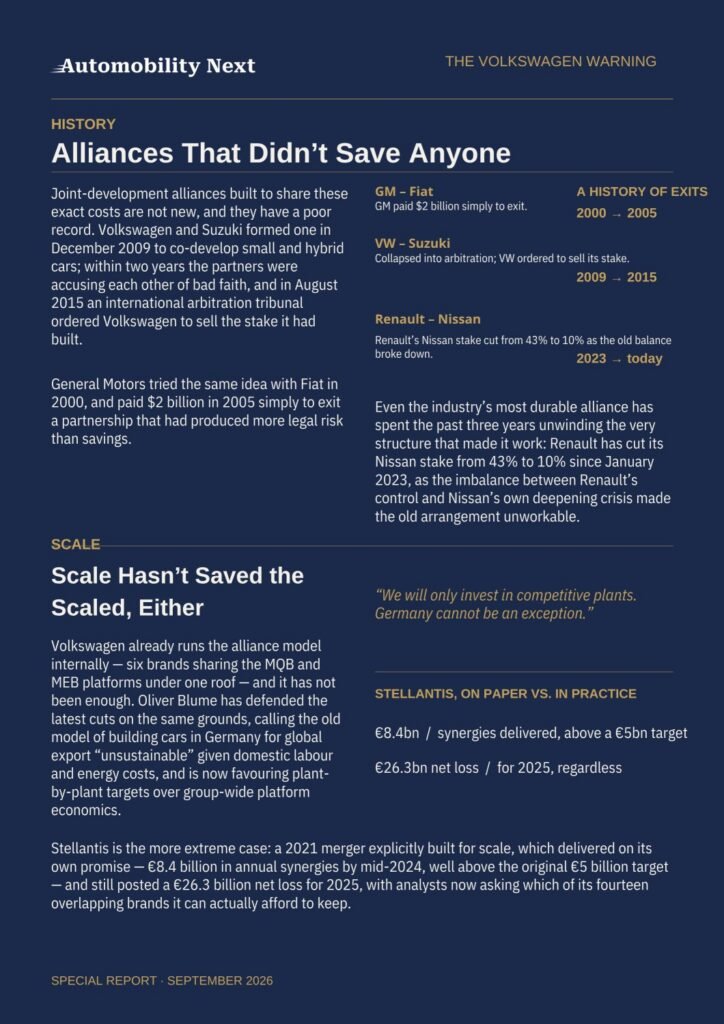
Joint-development alliances built to share these exact costs are not new, and they have a poor record. Volkswagen and Suzuki formed one in December 2009 to co-develop small and hybrid cars; within two years the partners were accusing each other of bad faith, and in August 2015 an international arbitration tribunal ordered Volkswagen to sell the stake it had built.
General Motors tried the same idea with Fiat in 2000, and paid $2 billion in 2005 simply to exit a partnership that had produced more legal risk than savings. Even the industry’s most durable alliance has spent the past three years unwinding the very structure that made it work: Renault has cut its Nissan stake from 43% to 10% since January 2023, as the imbalance between Renault’s control and Nissan’s own deepening crisis made the old arrangement unworkable.
Scale Hasn’t Saved the Scaled, Either
Volkswagen already runs the alliance model internally — six brands sharing the MQB and MEB platforms under one roof — and it has not been enough. VW’s own finance chief, Arno Antlitz, put it bluntly in January 2025: “We will only invest in competitive plants. Germany cannot be an exception”. Oliver Blume has defended the latest cuts on the same grounds, calling the old model of building cars in Germany for global export “unsustainable” given domestic labour and energy costs, and is now favouring plant-by-plant targets over group-wide platform economics.
Stellantis is the more extreme case: a 2021 merger explicitly built for scale, which delivered on its own promise — €8.4 billion in annual synergies by mid-2024, well above the original €5 billion target — and still posted a €26.3 billion net loss for 2025, with analysts now asking which of its fourteen overlapping brands it can actually afford to keep.
The Gap Alliances Were Never Built to Close
That pattern points to a specific failure. Alliances and mergers share the cost of running an already-similar business: platforms, purchasing and engineering among companies with comparable labour costs, comparable Western supply chains and comparable multi-year development cycles. None of that touches the actual size of the gap with Chinese rivals.
Rhodium Group’s cost teardown puts BYD’s per-vehicle cost advantage over Tesla at roughly $4,700, with about three-quarters of it coming from vertical integration — BYD makes some 80% of its own components, against 37% for Tesla — and lower R&D and administrative overhead; government subsidy accounts for only about 5% of the gap. Sharing a platform with another European carmaker, or merging with one outright, does not create that kind of vertical integration or cut that kind of overhead.
It only spreads a Western cost structure across more vehicles, in a market that is itself close to a fifth smaller than it was in 2019. That is what is really impacting Europe’s carmakers: not an absence of scale, which most of them now have in some form, but a cost structure and a shrinking market that scale alone was never designed to fix.
One Company’s Cuts, Everyone’s Problem
Volkswagen’s 100,000 job cuts will dominate headlines because Volkswagen is the biggest name and the German government has the most political stake in the outcome. Strip away the scale, though, and the same pressures are visible everywhere: a market that has not recovered, a Chinese competitor with a structural cost advantage that no European alliance has matched, executives paying with their jobs for it, and margins thinning across the board even at companies, like Stellantis, that already did the merger meant to fix this.
Volkswagen’s board has bought itself roughly a decade to prove a smaller company can work. Every other name in this piece is on the same clock, and none of them has a partner left to share the bill with.
Related Stories
Tata’s €3.8 Billion Iveco Deal Buys Europe’s Bus Leader, an Engine Maker and a Margin Problem
Tata Motors has won access to Iveco's European and Latin American markets, its established technologies and its manufacturing...

Swap, Charge, Share: How Cross-Stakes Could Fix India’s EV Charging Headache
Picture this. Two of China's biggest EV rivals, who spent years fighting for the same buyer, suddenly decide...
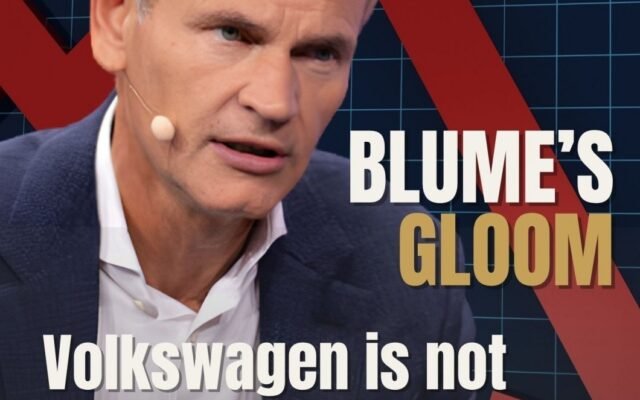
Volkswagen is not choosing India. It is affording it.
Škoda and Volkswagen executives flew to Mumbai to hail India as a priority. Days later, their chief executive...