
AI influences car buying, but 90% of consumers still purchase through dealerships: Bain & Company
Survey of 12,351 consumers highlights regional differences in buying priorities, EV adoption barriers and growing competition for automakers.

Artificial intelligence is changing how consumers research and choose cars, but dealerships continue to play a central role in vehicle sales. Around 90% of consumers globally still complete their purchases offline, even as digital platforms increasingly shape their buying decisions, according to a Bain & Company survey.
The Global Auto Consumer Survey: Regional Trends in a Changing World found that more than 80% of consumers combine online and offline channels during their purchase journey, while over six in 10 begin their search online.
The findings underline how automakers must adapt to changing consumer behaviour, with technology, pricing, electrification and brand loyalty emerging as key factors influencing purchase decisions.
AI gains ground in car buying
AI tools are becoming an increasingly important part of the car-buying process, helping consumers research vehicles, compare features and narrow down their choices. Adoption is particularly strong among younger buyers in markets such as India.
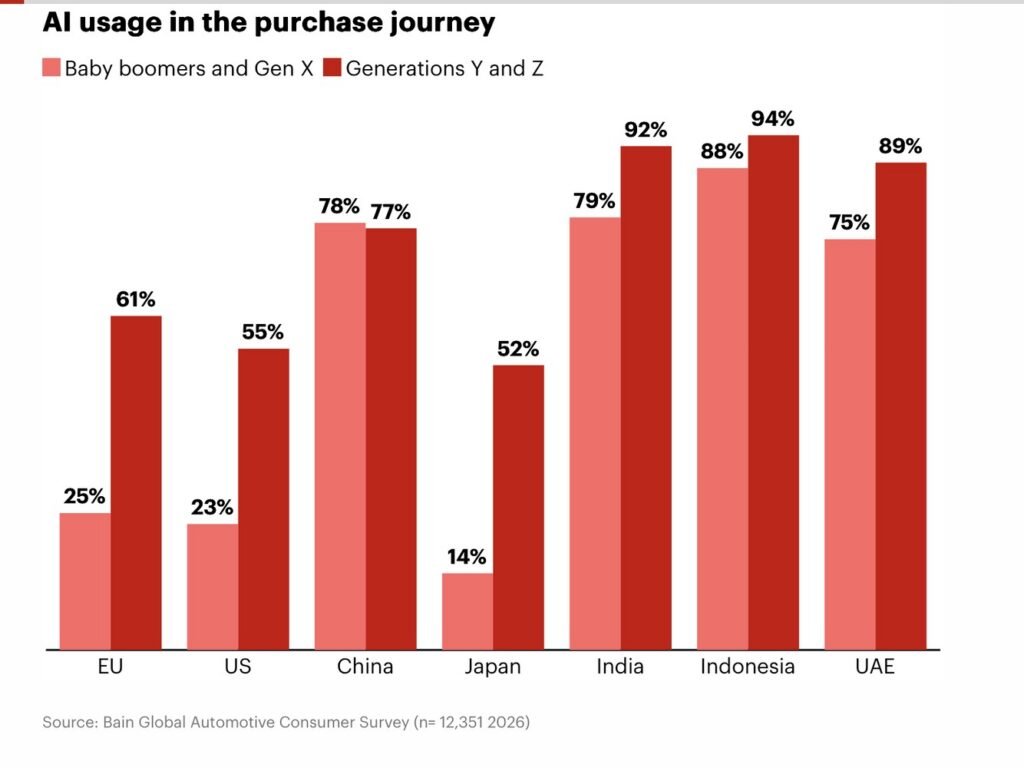
China is further ahead in digital automotive retail. About 95% of surveyed consumers there use both online and offline channels. Meanwhile, 84% of mass-market buyers and 88% of premium buyers said they would consider purchasing a vehicle entirely online.
However, the continued importance of dealerships shows that digital research has not replaced the need for physical interaction. Showroom visits, test drives and direct engagement with dealers remain important in the final purchase decision.
Price drives Western markets, technology leads in China
Price remains the biggest purchase consideration for consumers in the US and Europe, cited by 68% and 62% of respondents, respectively. In China, technology and vehicle features take precedence, with 58% identifying them as a key factor.
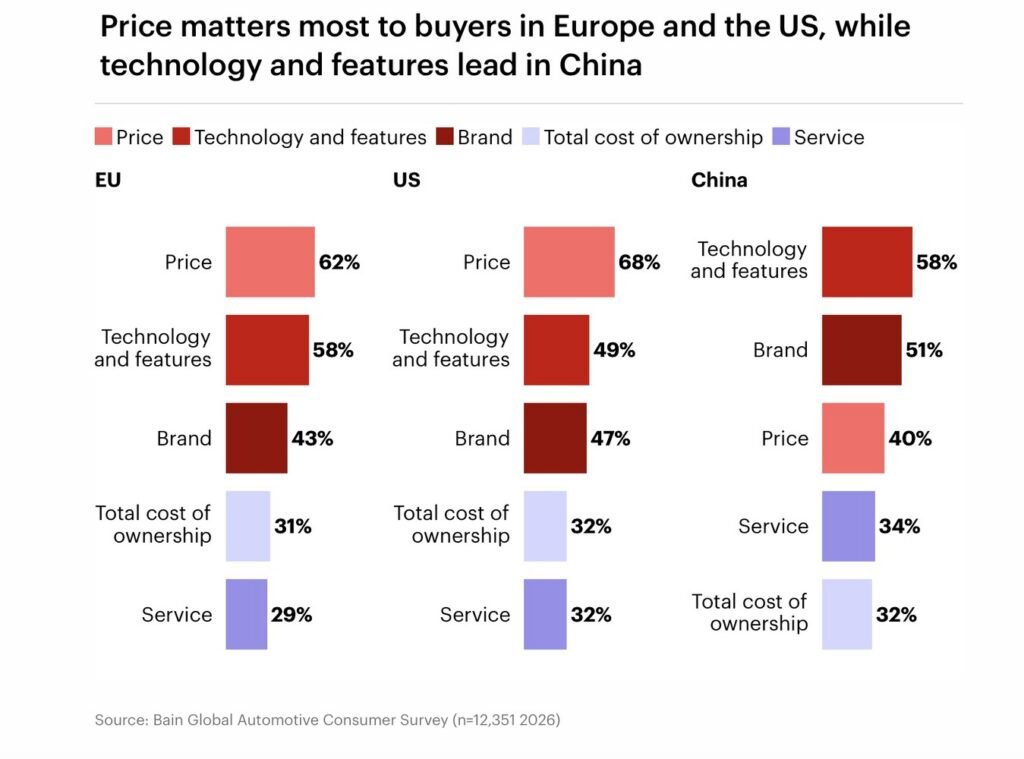
The difference highlights the challenge for global automakers, which must adapt their products and strategies to local preferences. While competitive pricing remains critical in Western markets, technology and features are increasingly important to Chinese buyers.
EV adoption held back by cost and charging concerns
Despite growing interest in electric vehicles, concerns over affordability and charging convenience continue to limit adoption. In the US and Europe, around six in 10 consumers unwilling to buy a battery electric vehicle (BEV) said they would not pay more for one than for a comparable petrol or diesel vehicle. Nearly half also cited charging times as a concern.
Experience could help address some of these reservations. Consumers who have test-driven a BEV are up to 2.2 times more likely to consider buying one than those who have not, the survey found.
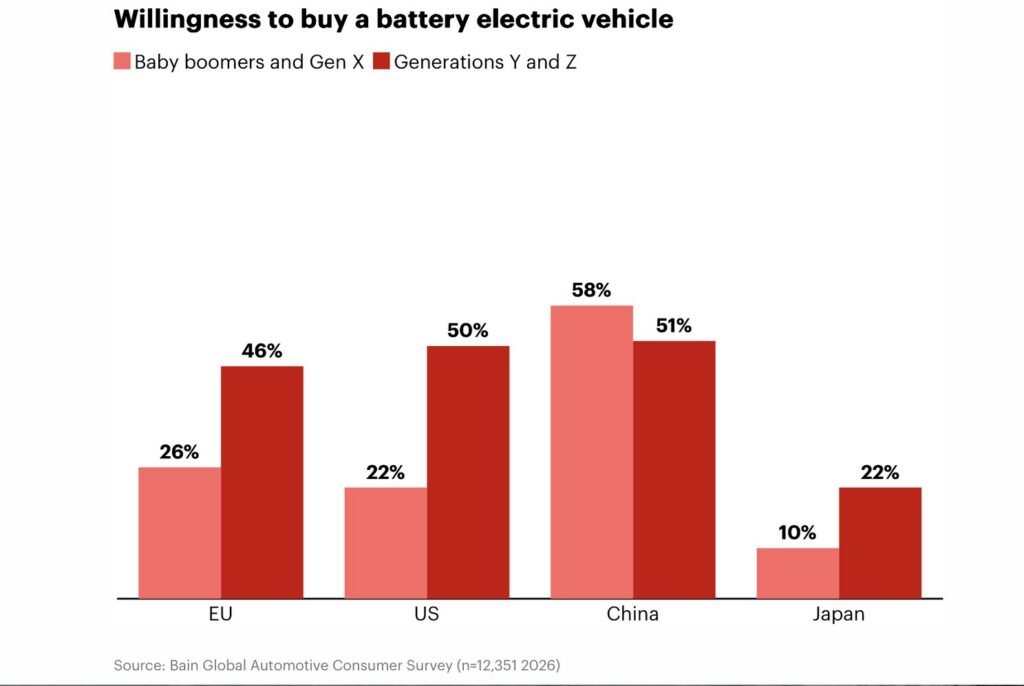
The findings point to the importance of competitive pricing, better charging infrastructure and wider access to test drives in building consumer confidence in electric mobility.
New brands put loyalty to the test
Traditional automakers are also facing greater competition from new entrants. More than a third of consumers in Western markets are open to considering newer brands, putting pressure on established manufacturers to strengthen their product offerings and customer appeal.
Interest in advanced driving technology varies sharply by region. While 84% of Chinese consumers would consider buying a vehicle with at least Level 3 autonomous driving capability, the figure drops to 47% in Europe and 40% in the US.
The findings suggest that automakers will need to keep pace with changing expectations around technology and vehicle features to retain customers and attract new buyers.
Profit margins add to industry pressure
The changing consumer landscape comes as the global automotive industry faces weak sales growth and rising investment demands. Bain noted that vehicle sales in Europe, North America, Japan and South Korea remain below their 2017 peaks, while average automaker profit margins fell to around 3% in 2025.
For manufacturers, the challenge is to balance investment in new technologies with affordability, profitability and changing customer expectations.
The survey points to a clear priority for the industry: combine digital convenience with strong dealership networks, competitive pricing and products tailored to regional demand. As buying habits evolve, understanding what consumers value in each market will be critical to staying competitive.
Related Stories
Old guard seizes India’s EV market as September sets a record and Ola shrinks
Tata and Mahindra doubled electric car registrations, TVS and Bajaj took half the electric two-wheeler market, and the...